
The Artist
Antonio Hase
Antonio Hase was born in 1963 in Western Bosnia under the surname Draganović. He arrived in Hamburg in 1984, later moved to Lucerne, and has since lived and worked in Munich. A remarkably versatile artist — painter, novelist, screenwriter, actor and director — he has dedicated over forty years to the visual arts.
He has participated in group exhibitions since 1985 and solo shows since 1986, with ten solo exhibitions to his name. His works are held in private collections in Germany, Switzerland, Canada, Croatia and the USA. As a Croatian-German painter, he has gained increasing international recognition in recent years.
His painting is rooted in abstraction — a commitment formed in the mid-1980s through his friendship with Vlado Kristl, who introduced him to the world of abstraction and to the great German Informel painter Emil Schumacher. Over four decades of work spanning from constructivism to deconstructivism, he has established himself as a pioneer of deconstructivism in painting.
Inspirations and dedications – Emil Schumacher, Vlado Kristl and Antonio Hase
"The motif of my painting is always a dedication to Schumacher and Kristl."
Antonio Hase's artistic path was shaped by encounters with great names of world art. As early as the eighties, his friend Vlado Kristl introduced him to the German painter Emil Schumacher. That meeting left a deep mark on Hase, awakening a profound bond with abstract expression to which he has remained faithful ever since.
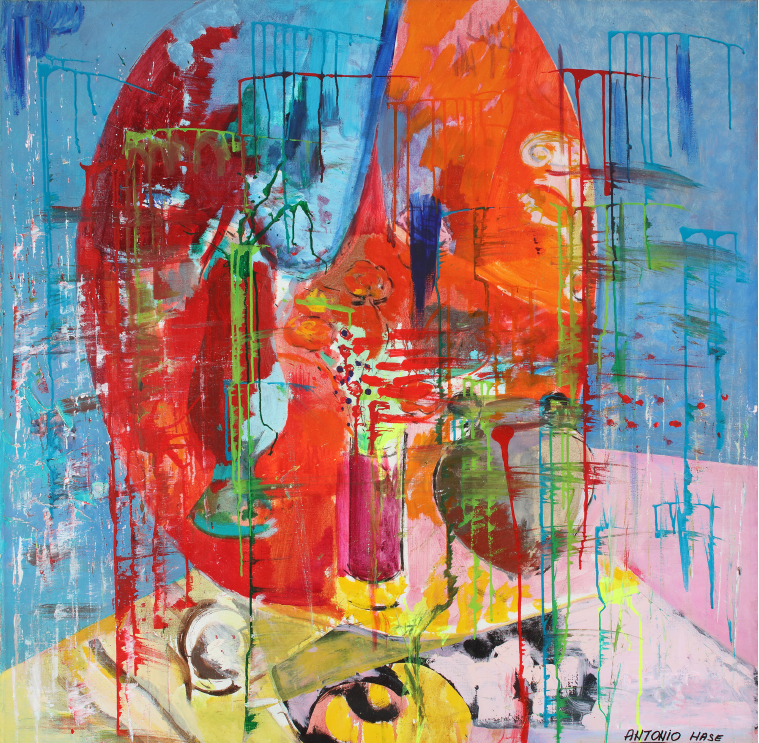
At that meeting Hase promised Schumacher that he would follow his path and devote himself to abstraction. Although both Schumacher and Kristl have since passed away, their presence lives on strongly in Hase's work. He turned their legacy into one of his significant works – a painting with the motif of a monument and an urn as a symbolic dedication to Schumacher, while scattered flower petals fall onto the urn in memory of Vlado Kristl.
Hase explains that the petals of Kristl's flowers also carry a personal meaning – they stand for the moment Kristl introduced him to Schumacher. The painting was exhibited and drew great interest, although at the time the artist had no chance to speak about its meaning in detail. Today he wants to share that story and show the deeply personal dimension of his work.
With these works Antonio Hase not only keeps the memory of his friends and mentors alive, but shows that art can be a bridge between generations and a lasting message of gratitude.